
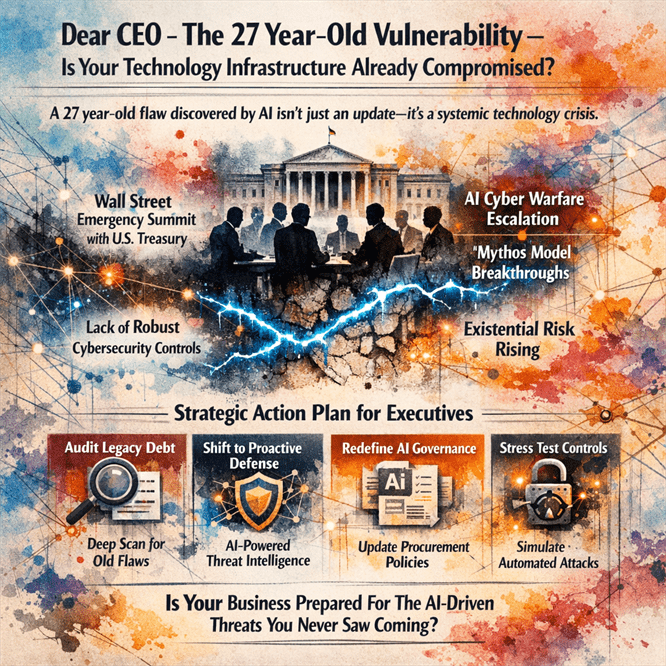
When an AI model discovers 27 year-old vulnerabilities that human engineers missed, it is no longer a tech update.
It is a systemic technology crisis.
The recent emergency summit between Wall Street’s elite and U.S. Treasury officials underscores a chilling reality.
Frontier models like Anthropic’s "Mythos" are redefining the boundaries of cyber warfare.
As these capabilities proliferate, the widespread lack of robust cybersecurity controls within organizations is about to become an existential liability.
Let that sink in for a moment, cyber attacks on your business are about to exponentially explore.
We are shifting from an era of manual patching to one of hyper-accelerated, AI-driven offense that can bypass decades of established security protocols.
For the C-Suite, the mandate is clear: the gap between AI capability and traditional defense is widening into a chasm.
Strategic Action Plan for Executives
Audit Legacy Debt
Initiate an immediate deep-scan of "legacy" infrastructure. If an AI can find 27 year-old flaws in supposedly secure systems like OpenBSD, your older, unmonitored assets are your greatest exposure.
Shift to Proactive Defense
Move away from reactive security. Evaluate participation in industry-wide intelligence-sharing consortiums to leverage AI-driven defensive tools before they are weaponized by bad actors.
Redefine the AI Governance Framework
Update your AI procurement and usage policies. Ensure that "AI-readiness" includes a rigorous assessment of how new models impact your specific attack surface.
Stress Test Control Environments
Strengthen internal cybersecurity controls specifically against "automated exploitation." If your current controls rely on human-speed detection, they are already obsolete.
Is your organization prepared for a world where the most dangerous threats are the ones you didn't even know existed?
#CyberSecurity #AI #DigitalTransformation #RiskManagement #Leadership #GenerativeAI #DearCEO #CEO