
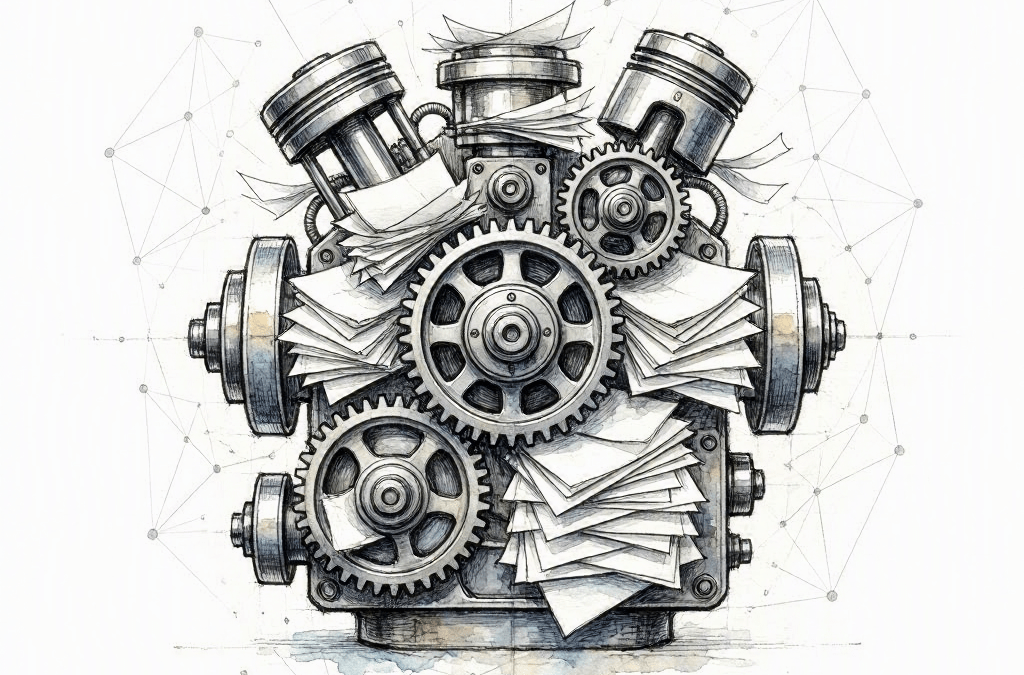
Dear CEO – Automating your compliance engine won’t reduce your risk

Dear CEO – Automating your compliance engine won’t reduce your risk

It will only increase the speed at which you fail.

We have built massive organizational compliance engines.
These engines are not designed to solve problems.
They are designed to shift the burden of risk from Middle Managers (the center) to the frontline.
Or from the headquarters to the regions.

It is a mechanism for moving accountability without actually exercising authority.

When leadership cannot direct the work, they create a rule.
When the rule fails, they create a new rule.
This is the cycle of sludge.
It creates a massive industry of auditors and reporting layers that do nothing but track the failure.

Now, leadership is looking to AI to fix it.
That is a catastrophic mistake.

If you use AI to automate a compliance engine, you are just automating the sludge.
You are building a machine that generates meaningless paperwork at lightning speed.
You are creating a high speed version of a broken system.
You are automating the symptom rather than the cure.

Real AI strategy is not about automating the audit.
It is about blowing up the need for the audit.

The goal is not to build a better reporting layer.
The goal is to use AI to provide real time visibility that makes the reporting layer obsolete.
Use AI to empower frontline decision making so you do not need a manual to tell them what to do.

Don't automate the cage.
Destroy it.

Here's your action plan:
1. Identify your sludge.
Find where you are measuring activity instead of outcomes.

2. Automate the work, not the report.

If the AI only makes the paperwork move faster, you have failed.

3. Reinvest the savings into real authority (human decision making at speed).

Take the budget you spent on the compliance layer and give it to the people making the decisions.

Are you automating your compliance or are you automating your obsolescence?

Let's discuss below.

#AI #Leadership #Compliance #Strategy #Management #DearCEO #CEO

Dear CEO: The AI Consumption Trap

Dear CEO: The AI Consumption Trap

If you are a CIO, your biggest threat is no longer the GenAI technology.

It is the math.

We are moving from the certainty of software licenses to the chaos of a digital utility bill.

For decades, IT budgets were predictable.

You bought a license, and you knew the cost.

Now, frontier model providers are shifting to pure consumption models based on token usage.

The promise of AI autonomy is a dual edged sword.

When you deploy autonomous agents to automate tasks, you are essentially hiring digital employees with unlimited credit cards and zero concept of overtime.

I have watched agents loop through tasks, burn through tokens, and get everything wrong while the bill keeps climbing.

It is exactly like the electricity bill.

If you leave the lights on, you do not see the damage until the end of the month.

The FOMO that drove GenAI adoption over the last two years is hitting a massive wall of financial reality.

If you do not govern the consumption, the consumption will govern your budget.

Here is how you protect the bottom line:

1. Implement strict token based guardrails at the architectural level.

2. Move from annual budget forecasting to real time consumption monitoring.

3. Reframe the AI conversation from capability to unit economics.

Is your organization ready for a budget that scales with your errors?

#AIStrategy #ITGovernance #DigitalTransformation #CFO #CIO #GenerativeAI #DearCEO #CEO

Dear CEO – You care more about your office air conditioning than your company’s data nervous system

Dear CEO – You care more about your office air conditioning than your company’s data nervous system

If your HVAC fails, the board meets immediately to solve it.

If your data pipelines crash, you might not even know until your reports are empty and operations freeze.

We systematically underinvest in the plumbing that moves and transforms our data because it is invisible.

Unlike buildings or machinery, these pipelines do not sit on a balance sheet.

They have no facilities manager and no visible maintenance schedule.

Yet they are the silent connectors between every operational system you rely on.

Treating data plumbing as a background task is a strategic failure in risk management.

Digital resilience requires viewing data pipelines with the same urgency as cybersecurity.

The pipes nobody can see are usually the ones that break first.

If your AI strategy depends on these invisible lines, you are building a liability rather than an asset.

Action Plan for Executives:

Demand a Data Dependency Map to visualize exactly how data moves from source to decision point.

1. Establish a Data Infrastructure Risk Registry that treats pipeline failure as a Tier 1 business risk.

2. Shift budget allocation from front end AI tools to the underlying data engineering and maintenance required to sustain them.

3. Require a quarterly resilience report on data latency and pipeline health for board review.

When was the last time your board reviewed a data infrastructure risk assessment?

#Leadership #DigitalTransformation #AI #CEO #DearCEO #DataStrategy