

Dear CEO – Why the Next Employee Perk Will Be an AI Token Bank — Not a Stock Option

Dear CEO – Why the Next Employee Perk Will Be an AI Token Bank — Not a Stock Option

Earlier this week Jenson Hwang (NVIDIA's CEO) keynote announced that “every engineer will need an annual token budget to be roughly half of their base salary paid as AI‑tokens to amplify productivity 10×.”

This creates a new hiring perk that can attract top talent while giving employees a measurable “AI spend” they can use to call on autonomous agents, schedule cron jobs or retrieve data in any modality.

At the same time, the Big Tech industry is signalling moving from flat‑rate SaaS licences to a utility‑pricing model for agentic AI.

You pay per token consumed rather than a static subscription.

Get Ready!

To succeed, every enterprise must adopt an agentic‑AI strategy with built‑in policy engines and privacy guardrails that keep token‑driven agents from leaking sensitive data.

For CEOs, CHROs and CAIOs this means a new line‑item on the P&L, fresh talent‑acquisition levers, and an urgent need to embed token accounting into HR, finance and security workflows.

Are you ready to redesign compensation and governance around AI tokens, or will your organization be left behind in the agentic era?

#AILeadership #AgenticAI #DigitalTransformation #FutureOfWork #TokenEconomics #EnterpriseSecurity #CEO #DearCEO
Dear CEO – Your AI Playbook Expires in 18 Months – Why a Five‑Year Plan Is Now a Liability

Dear CEO – Your AI Playbook Expires in 18 Months – Why a Five‑Year Plan Is Now a Liability

You spent six months building an AI strategy.

It was obsolete before the ink dried.

That is not a failure.

It is the physics of this moment in technology history.

In most domains, a multi-year strategy is a reasonable management instrument.

With AI, it is a liability.

The capability landscape such as the Gen AI models, infrastructure, cost curves, regulatory posture, use cases are shifting so rapidly that any strategy with a three to five-year horizon is making foundational bets on a world that will not exist.

Smart organizations are replacing static AI strategies with rolling capability reviews, 90-day execution sprints, and scenario based planning that treats uncertainty as an input rather than an obstacle.

The question is not what is your AI strategy for 2028.

It is how do we make better AI decisions every quarter.

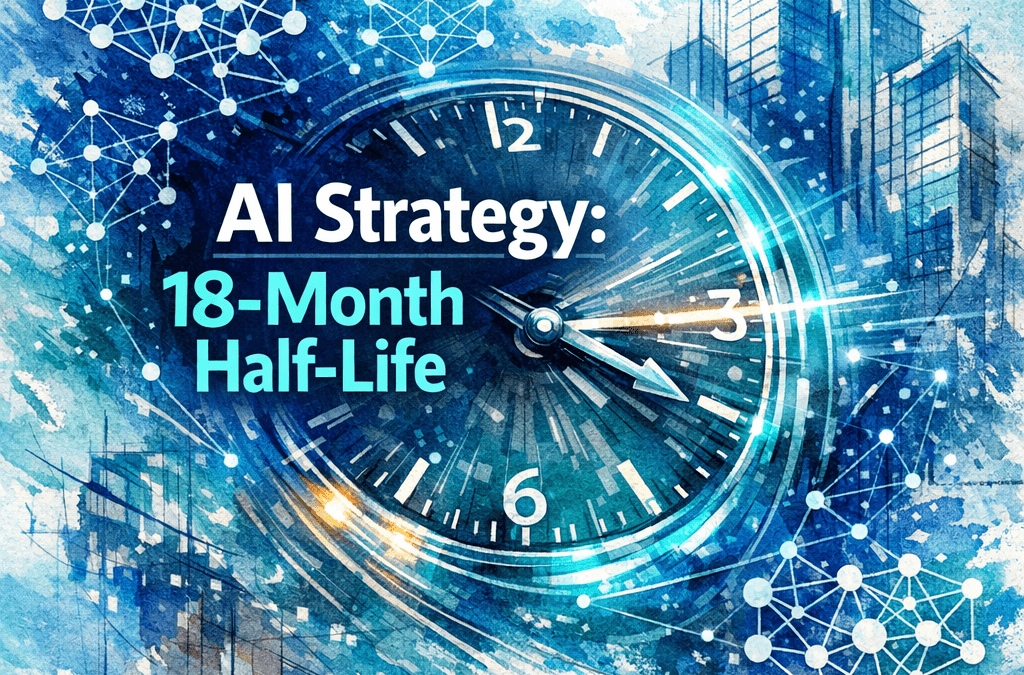
The reality of AI today is a half‑life of 18 months.

Models, infrastructure costs, vendor capabilities and regulations evolve so fast that any multi‑year roadmap is a gamble on a future that won’t exist.

Why it matters:
Executives who shift from “AI 2028” to “AI every quarter” unlock faster time‑to‑value, reduce sunk cost risk, and keep their organizations ahead of regulatory and cost curves.

Your competitive edge depends on how quickly you can decide not on how long your plan lasts.

Start by mapping the AI landscape on a quarterly basis this becomes your “living strategy”.

Then run focused 90‑day sprints that deliver tangible outcomes, feeding results back into the next radar.

Finally, embed scenario planning into every sprint review so uncertainty drives action rather than paralysis.

Executing this loop turns rapid change from a threat into a competitive advantage.

Your 3‑step Checklist Action Plan

1. Quarterly Capability Radar
Convene a cross‑functional AI council every 90 days to map new model releases, cost trends, and regulatory updates. Document gaps vs. current stack.

2. Sprint‑Based Execution
Translate radar insights into 30‑day sprints with clear KPIs (e.g., prototype a new LLM, pilot a cost‑optimization tool). Review outcomes before the next sprint.

3. Scenario Playbooks
Develop three concise playbooks (optimistic, realistic, pessimistic) outlining resource allocation and risk mitigation for each AI trajectory. Update them after every radar session.

#AILeadership #DigitalTransformation #StrategicPlanning #CEO #CAIO #Innovation #DearCEO

Dear CEO – Why Piloting AI Is No Longer Enough – The 3× Revenue Playbook CEOs Need (PwC Study)

Dear CEO – Why Piloting AI Is No Longer Enough – The 3× Revenue Playbook CEOs Need (PwC Study)

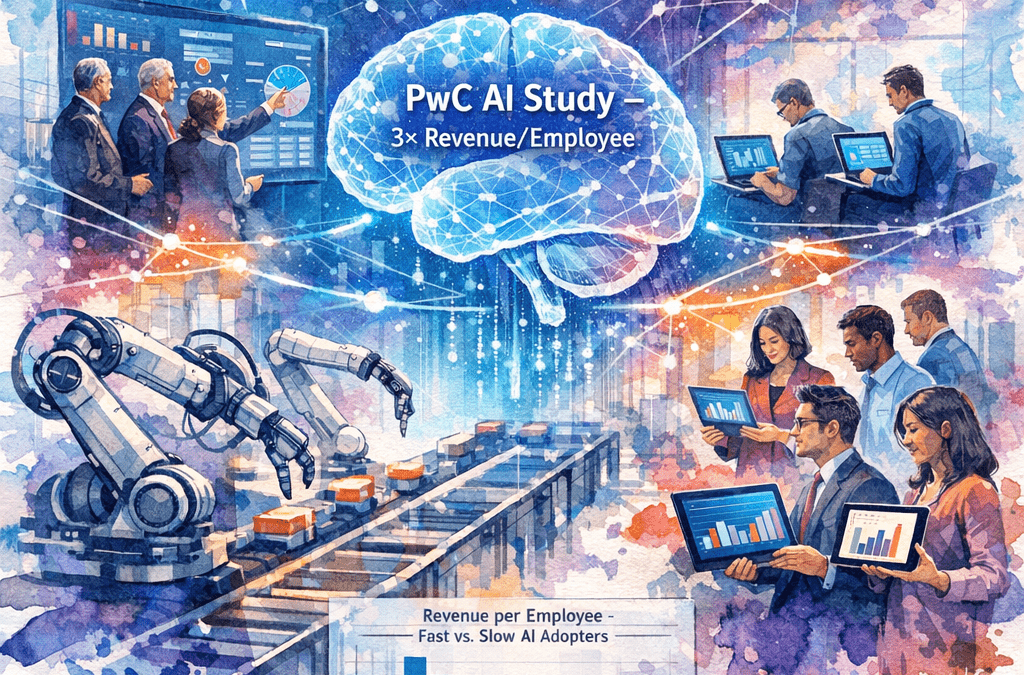
According to PwC’s latest AI adoption study, CEOs who move beyond pilots are unlocking up to three times more revenue per employee.

Are you still stuck in the proof‑of‑concept stage?

The research reveals a stark split: boards demand clear ROI, senior management worries about investment returns, and employees fear job displacement. 

PwC data shows that firms accelerating AI adoption achieve 3× higher revenue per head than slower peers, proving that scaling is the true value driver. 

A follow‑up survey of 50,000+ workers found those already using AI are far more optimistic about productivity and creativity, underscoring the C‑suite’s duty to fund rapid upskilling. 

At the same time, AI‑augmented robotics is emerging as a strategic growth lever that will reshape value chains across industries. 

Action plan for senior executives

1. Benchmark with industry productivity data benchmarks – Use the study’s ROI and revenue‑per‑employee metrics to set internal targets and track progress quarterly.

2. Stakeholder alignment workshop – Convene board members, senior managers, and employee representatives to co‑create an AI vision that ties directly to the 3× revenue goal.

3. Enterprise‑wide scaling roadmap – Identify three high‑impact processes, allocate cross‑functional squads, and launch production‑grade AI models within a 12‑month horizon, replacing isolated PoCs.

4. Rapid upskilling program – Deploy role‑based AI curricula (prompt engineering, data literacy, ethics) with internal “AI champions”; aim for ≥80 % skill adoption among employees in six months, mirroring the optimism gap PwC uncovered.

5. Governance & change‑management office – Establish a dedicated team to monitor technology velocity versus organizational readiness, ensuring continuous alignment with board expectations.

What concrete steps are you taking to turn AI from experiment into enterprise engine while future‑proofing your talent?

#AILeadership #DigitalTransformation #FutureOfWork #CIO #CEO #DearCEO