


Dear CEO – Why Zero Errors is a Death Sentence in an AI Transformation
Your transformation is already dead
Most transformations look perfect on a PowerPoint deck.
They have milestones.
They have KPIs.
They have beautiful Gantt charts.
But if you look at the ground level, the engine is stalling.
Most leaders are flying blind.
They believe that a lack of reported errors means the transformation is succeeding.
It actually means the information flow has stopped.
You are managing an illusion of progress.
This is the most expensive mistake a C-suite leader can make.
You are treating a complex systemic shift like a simple checklist.
When you do this, you create a lethal gap between the boardroom and the reality of the frontline.
The gap is called the Failure to Learn.
In a high stakes environment, there are two ways to fail.
First is the Preventable Failure.
This is a breach of standard procedure.
It is sloppy.
It is a deviation from known processes.
It is unacceptable.
Second is the Intelligent Failure.
This is a novel foray into new territory.
It is the byproduct of a legitimate experiment.
The catastrophe happens when leaders treat them as the same thing.
If you punish the intelligent failure, you ensure that no one will ever report the preventable one.
You create a culture where people hide the very data you need to survive.
You turn your most expensive experts into silent observers of their own demise.
To fix this, you must rebuild your organizational architecture.
You must stop running autopsies.
An autopsy is an examination of a corpse.
By the time you are conducting a post mortem, the transformation is already dead.
You need a ritualized way to hear the truth while the patient is still alive.
You need a Pre Mortem.
You need a Braintrust.
You need to move from a culture of compliance to a culture of candor.
Stop presenting a Plan.
A Plan implies the outcome is certain.
A Plan assumes you have already solved the problems.
In a VUCA world, a Plan is a lie.
Start presenting a Hypothesis.
A Hypothesis admits that you do not know everything.
A Hypothesis invites your team to test the reality of your assumptions.
It turns a mistake into a data point.
It turns a failure into an asset.
If you want your transformation to succeed, you must change your relationship with the truth.
Stop asking for reports that tell you what you want to hear.
Start asking for the data that tells you what you need to know.
If you do not know what is going wrong, you do not know if you have already failed.
Let's discuss.
#Leadership #DigitalTransformation #PsychologicalSafety #Strategy #DearCEO #CEO

Dear CEO – Your high performance culture is a ticking time bomb
Most companies that look perfect on paper are actually dead inside.
They just haven't collapsed yet.
On the surface everything looks flawless.
The quarterly metrics are met.
The milestones are hitting.
The CEO feels in control.
But underneath the surface is a lethal feedback vacuum.
In a VUCA world this is called the Anxiety Zone.
It is the intersection of high performance standards and low psychological safety.
This is where leaders mistake compliance for commitment.
They believe they are driving excellence through discipline.
In reality they are creating a lobotomy of the entire organization.
In the Anxiety Zone information only travels in one direction: down.
The most critical data points are being intercepted by the fear of looking stupid or being wrong.
Your experts are no longer solving problems.
They are busy managing your perception of them.
This creates an Intelligence Bottleneck.
You are paying for a thousand brains but you are only receiving the signals of one.
In an era of extreme complexity command and control is a death sentence.
You cannot command your way through a crisis.
You can only learn your way through a crisis.
The shift required is the move from the Anxiety Zone to the Learning Zone.
This is not a soft HR initiative.
This is a strategic pivot for survival.
In the Learning Zone high standards are paired with high safety.
People don't just execute.
They investigate.
They debate.
They admit when the strategy is failing so they can fix it before it becomes a headline.
If you want to know if your organization is a ticking time bomb, run this audit on Monday morning.
First ask your team.
What is one thing you are afraid to tell me?
Second ask.
What am I getting wrong about our current strategy?
Third ask.
Are we actually solving problems or are we just following the plan?
If they hesitate you have your answer.
If they answer with silence you are already in the Anxiety Zone.
The question is not whether you can handle the truth.
The question is whether you can afford the cost of the lie.
#Leadership #PsychologicalSafety #Strategy #VUCA #OrganizationalCulture #DearCEO #CEO

Dear CEO – We are trying to lead a high speed race while the crew is busy dropping the anchor
Executives see a competitive gold rush.
Employees see a threat to their survival.
The latest data reveals a massive perception gap.
76% of leaders believe their teams are enthusiastic about AI.
Only 31% of employees actually feel that way.
This is not a simple communication failure.
It is a fundamental alignment crisis.
When leaders chase AI because of FOMO.
And employees resist AI because of fear.
Transformation dies in the middle.
You cannot drive speed if your workforce is busy bracing for impact.
If you want true AI maturity, you must pivot.
1. Shift from efficiency to enablement.
Use AI to augment human skill rather than just cutting headcount.
2. Prioritize co-creation over mandates.
Stop rolling out tools and start solving problems with the people using them.
3. Own the narrative.
If the goal is cost reduction, stop calling it digital transformation.
Honesty builds more trust than euphemisms.
Are you using AI to grow your business, or are you just using it to shrink your staff?
Let's discuss.
#ArtificialIntelligence #Leadership #DigitalTransformation #FutureOfWork #ExecutiveStrategy #DearCEO #CEO

Dear CEO – There are two types of CEOs in the AI era
Those who lead the machine, and those who are managed by it.
Most leaders think they are buying a tool.
They are actually delegating their judgment.
In the previous era of digital transformation, software was a utility.
You used it to process data or automate a specific workflow.
If the system failed, it was a technical error.
If it worked, it was simply a tool in the hands of your staff.
You remained the architect of the strategy.
You were the one deciding what the data meant and how it influenced the business.
AI is not a utility.
It is a logic engine.
When you implement generative AI or autonomous agents, you are not just installing software.
You are installing a decision making framework.
If you delegate the execution to the machine, the machine will eventually decide the strategy.
This is the point where the erosion of leadership begins.
If you do not govern the logic, you are no longer the pilot.
You are simply a spectator in a cockpit you no longer control.
You are being managed by your own infrastructure.
1. Move AI from the IT budget to the strategic boardroom.
2. Define your decision logic boundaries before the implementation begins.
3. Integrate AI performance directly into executive KPIs.
Are you building a machine to serve your strategy, or a machine that will eventually dictate it?
Let's discuss
#AIStrategy #Leadership #DigitalTransformation #ExecutiveStrategy #Governance #CEO #DearCEO
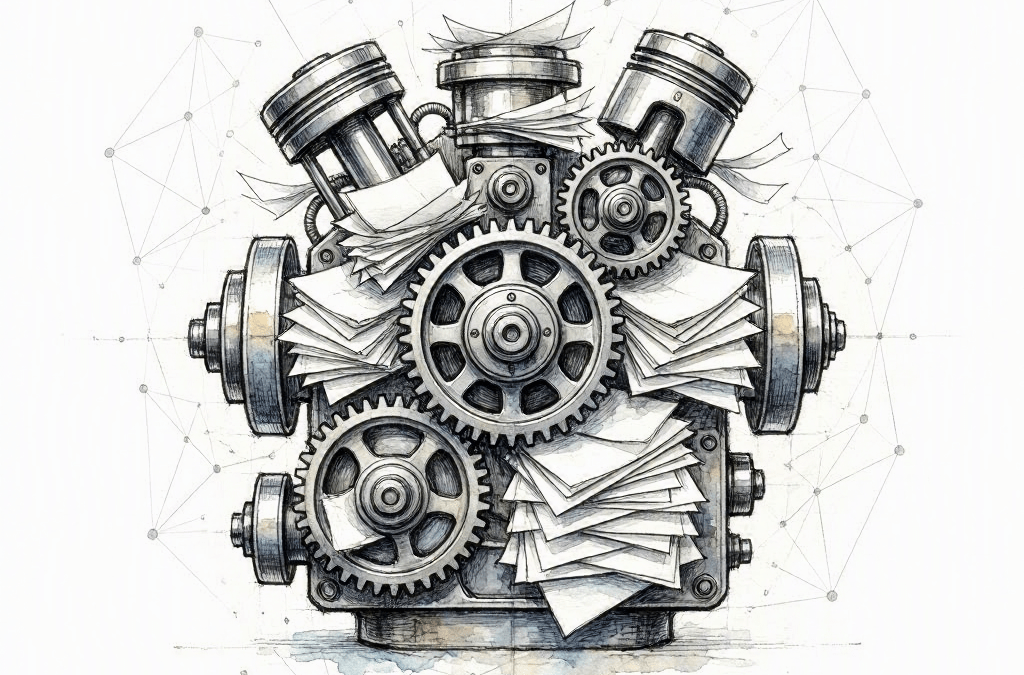
Dear CEO – Automating your compliance engine won’t reduce your risk
It will only increase the speed at which you fail.
We have built massive organizational compliance engines.
These engines are not designed to solve problems.
They are designed to shift the burden of risk from Middle Managers (the center) to the frontline.
Or from the headquarters to the regions.
It is a mechanism for moving accountability without actually exercising authority.
When leadership cannot direct the work, they create a rule.
When the rule fails, they create a new rule.
This is the cycle of sludge.
It creates a massive industry of auditors and reporting layers that do nothing but track the failure.
Now, leadership is looking to AI to fix it.
That is a catastrophic mistake.
If you use AI to automate a compliance engine, you are just automating the sludge.
You are building a machine that generates meaningless paperwork at lightning speed.
You are creating a high speed version of a broken system.
You are automating the symptom rather than the cure.
Real AI strategy is not about automating the audit.
It is about blowing up the need for the audit.
The goal is not to build a better reporting layer.
The goal is to use AI to provide real time visibility that makes the reporting layer obsolete.
Use AI to empower frontline decision making so you do not need a manual to tell them what to do.
Don't automate the cage.
Destroy it.
Here's your action plan:
1. Identify your sludge.
Find where you are measuring activity instead of outcomes.
2. Automate the work, not the report.
If the AI only makes the paperwork move faster, you have failed.
3. Reinvest the savings into real authority (human decision making at speed).
Take the budget you spent on the compliance layer and give it to the people making the decisions.
Are you automating your compliance or are you automating your obsolescence?
Let's discuss below.
#AI #Leadership #Compliance #Strategy #Management #DearCEO #CEO