
Dear CEO – Your best decisions are no longer your own

Dear CEO – Your best decisions are no longer your own

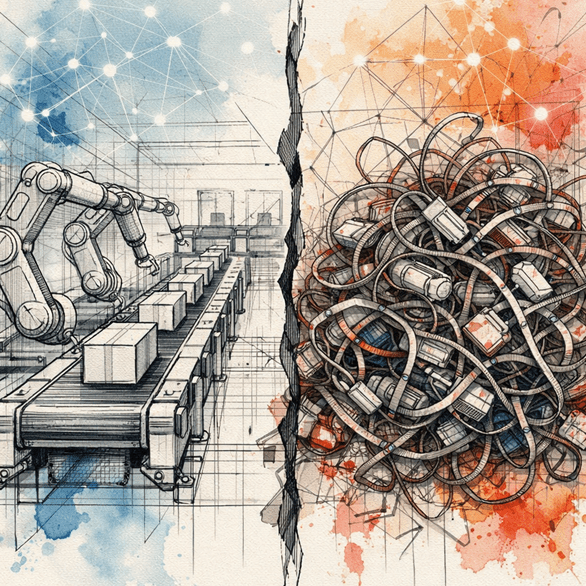
A single error in an autonomous system is rarely a technical glitch.

It is a failure of organizational architecture.

We are entering the era where AI shifts from recommendation to action, the role of the executive must move upstream.

We are entering an era where intelligence is not just a tool, but a participant in the operating system.

Most leaders still approach AI as a decision to be made.

They wait for a report, a dashboard, or a recommendation to arrive on their desk.

They attempt to maintain control by being the final checkpoint in a process that is already moving faster than they can review.

But when systems move from predicting what might happen to executing what must happen, the old model of oversight collapses.

If an agentic system manages customer disputes or optimizes pricing in real time, the decision has already happened by the time you see it.

The real risk is not the error itself.

It is the silence.

When an agentic system makes an error, it is not just a model failure.

It is a failure in the environment you designed.

If you have not defined the boundaries, the escalation paths, and the governance rails, you are not leading.

You are just watching a black box run.

To lead in the age of agentic AI, you must transition from being a decision maker to being a system designer.

You must govern the conditions under which intelligence operates.

If you want to scale intelligence, you must design the rails.

Build the guardrails before the train leaves the station.

Define the boundaries before the machine crosses them.

Architect the outcomes, not just the approvals.

#AIleadership #AgenticAI #DigitalTransformation #EnterpriseStrategy

Dear CEO – Your brand is being hijacked by whoever has the largest GEO budget

Dear CEO – Your brand is being hijacked by whoever has the largest GEO budget

SEO was about ranking.

Generative Engine Optimization (GEO) is about being the answer.

Recent reports show well funded actors are using ghost think tanks and massive volumes of AI generated content to seed specific narratives into the datasets used by models like ChatGPT or Claude.

Most CMOs are prepared to fight for visibility in a list of search results.

But in an AI driven world, you are no longer fighting for a link or a click.

You are fighting for the consensus.

If a model summarizes your company using a series of highly optimized and manufactured reports, your entire marketing budget becomes a secondary concern to whoever paid for the data layer.

You might think brand authority is anchored in real world transactions and high quality structured data. While those are essential, they are purely defensive.

A brand's reputation is often decided at the moment of inquiry, and if the AI response is skewed, the transaction never even starts.

1. Conduct a comprehensive audit of your brand summary across the three major LLMs to see exactly how they describe your current value proposition to users.

2. Track competitor patterns.

3. Prioritize the deployment of verifiable structured data to ensure your official facts are the ones being ingested.

When was the last time you checked what the machines are saying about you?

#BrandRisk #GenerativeAI #CMO #MarketingStrategy #AIResponsibility

Dear CEO – Your data is a liability if nobody owns it

Dear CEO – Your data is a liability if nobody owns it

Most AI programs are just expensive data cleaning exercises.

Without assigned owners and clear documentation, your AI team will spend 80 percent of their time on wrangling instead of building value.

Executives often fund AI expecting intelligence, but they are actually subsidizing a massive ongoing data janitorial service.

If your data lacks a product owner, your ROI will vanish in the plumbing.

Most companies think they are investing in intelligence.

They are actually paying for the effort of cleaning up a mess.

The intelligence you think you are buying is being consumed by the massive effort required to simply make the data usable.

Data is not an asset if no one is responsible for its quality.

I saw this clearly on every project we have undertaken as a firm.

The moment the implementation begins, the intelligence disappears into a black hole of data cleaning and uncoordinated dependencies.

Stop treating data as a byproduct of operations.

1. Assign business owners to specific datasets.

2. Treat data quality as a nonnegotiable product feature.

3. Measure the actual cost of unmanaged data.

How much of your AI budget is being spent on janitorial work?

#DataGovernance #EnterpriseAI #AIStrategy #DataProduct

Dear CEO – Effective leaders make fewer decisions in the AI era

Dear CEO – Effective leaders make fewer decisions in the AI era

It sounds like an abdication of power, but in an agentic world, it is the only way to expand.

We are shifting from predictive models to autonomous actors.

When systems start acting on their own, the leader’s job changes from selecting an option to designing the rails.

Value is not in the chat window.

Value is in the reduction of intervention.

If you are still reviewing every output, you will fail to lead an AI organization and are merely babysitting a very expensive, redundant version of your own mistakes.

Stop reviewing decisions and start designing the conditions for them.

First, define fixed guardrails.

Second, automate the escalation paths for when the system hits its limits.

Third, audit the logic of the loop rather than the outcome of the single task.

Are you building a decision making machine or a decision making bottleneck?

#AgenticAI #AILeadership #EnterpriseTransformation #DigitalTransformation #OperationalExcellence

Dear CEO – You are paying an intelligence tax for a moat that is evaporating

Dear CEO – You are paying an intelligence tax for a moat that is evaporating

The intelligence tax is crashing.

The cost of intelligence is decoupling from the value of the model provider.

Nvidia is moving from being a pure supplier to a direct competitor.

Their six billion dollar deal to license Poolside technology is a strategic strike against the proprietary dominance of OpenAI and Anthropic.

By absorbing the talent from Poolside into its Nemotron project, Nvidia is building an open weight ecosystem that aims to rival the most advanced frontier models.

This move follows a moment of extreme vulnerability for Poolside, when they faced a narrow window to secure a 40,000 GB300 cluster to maintain their operations.

The importance of this shift for the C suite cannot be overstated.

We are moving from an era of AI as a service to an era of AI as a localized asset.

When you rely on a closed proprietary API, you are essentially renting your intelligence.

You are paying a premium for a black box that you do not control and cannot host yourself.

As open weight models close the capability gap, that premium becomes a wasted cost.

Some argue that frontier models still lead in reasoning and specialized integration.

This is true today. But the gap is narrowing.

1. Audit your current API dependencies to identify high cost intelligence.

2. Test open weight models against your specific data to find the true performance gap.

3. Build a sovereignty roadmap that prioritizes hosting models on your own infrastructure.

Is your AI strategy a subscription or an asset?

#AIStrategy #DataGovernance #Nvidia #EnterpriseAI #AIsovereignty