
AI risk is no longer an IT problem

AI risk is no longer an IT problem

AI risk is no longer an “IT problem.”

It’s an executive accountability issue.

I was interviewed by The Data Wire about a shift I’m seeing across boardrooms and executive teams:

As generative AI scales, accountability is moving beyond IT and squarely onto the C‑suite.

A few key points from the conversation:

• Treating AI like traditional software is a mistake. Generative AI changes the risk model entirely especially when data, IP, and brand reputation are at stake.
• Data quality + AI governance are no longer technical hygiene items. They are business performance metrics.
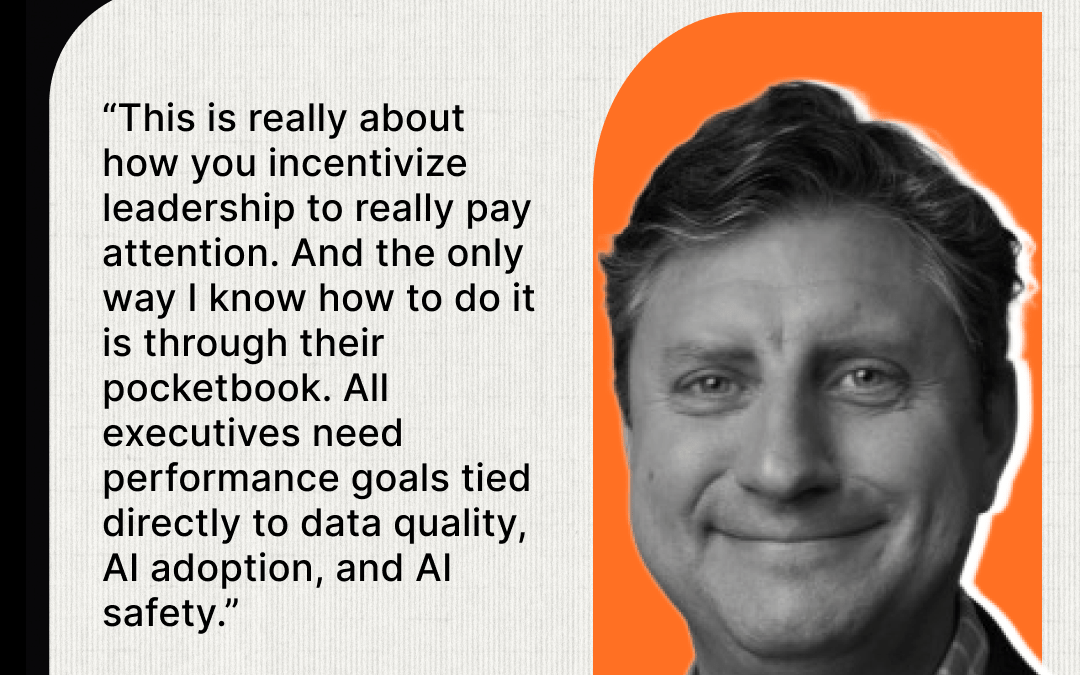
• The fastest way leadership attention changes? Tie AI risk, data quality, and AI safety to executive incentives.

Once AI governance is in place, the board’s job doesn’t stop. The real question becomes - What are we actively monitoring, and how fast would we know if something went wrong?

AI adoption succeeds or fails on leadership behavior not the tooling.

Full article: Executives Take Ownership of AI Risk as Accountability Shifts Beyond IT Teams (The Data Wire)

Curious how your organization is handling executive level AI accountability today. 

#AIGovernance #ExecutiveLeadership #BoardOversight #DigitalTrust #AIrisk #DataStrategy #AILeadership

Dear CEO – The Hidden Liability in Your AI Roadmap – Why Your Vendor Contracts are a Ticking Time Bomb

Dear CEO – The Hidden Liability in Your AI Roadmap – Why Your Vendor Contracts are a Ticking Time Bomb

4 lines that must be in every AI vendor contract or don’t sign.

As we accelerate AI adoption, many leaders are making a fatal mistake.

Treating software procurement like a simple utility purchase rather than a massive transfer of enterprise risk.

When you integrate third party AI, you aren't just buying a tool.

You are importing their vulnerabilities into your ecosystem.

To protect your organization, your contracts must move beyond basic SLAs to focus on four non-negotiable pillars: strict data usage boundaries, uncompromised audit rights, rapid incident notification protocols, and robust indemnities.

Without these clauses, you aren't driving innovation.

You are inheriting the vendor’s liability.

For the CEO or CAIO, the cost of a "blind" contract isn't just a technical glitch.

It is a catastrophic breach of customer trust and regulatory compliance.

True digital transformation requires the courage to slow down the legal review to ensure your AI scaling is both rapid and resilient.

Strategic leadership means ensuring that as your technology evolves, your defense mechanisms evolve with it.

Strategic Action Plan for Executives:
1. Immediate Audit
Task your Legal and IT Security teams to review all existing AI related vendor agreements against the four critical pillars (Data Usage, Audits, Notification, Indemnity).

2. Update Procurement Policy
Implement a mandatory "AI Risk Checklist" for all new software procurement processes involving LLMs or automated decision-making tools.

3. Define Thresholds
Establish clear enterprise risk thresholds that trigger manual executive review for any vendor contract involving high-sensitivity data processing.

Are you auditing your AI vendors, or are you simply hoping for the best?

#AIStrategy #DigitalTransformation #RiskManagement #CSuite #Leadership #CyberSecurity #DearCEO #CEO

Dear CEO – The 27 Year-Old Vulnerability – Is Your Technology Infrastructure Already Compromised

Dear CEO – The 27 Year-Old Vulnerability – Is Your Technology Infrastructure Already Compromised

When an AI model discovers 27 year-old vulnerabilities that human engineers missed, it is no longer a tech update.

It is a systemic technology crisis.

The recent emergency summit between Wall Street’s elite and U.S. Treasury officials underscores a chilling reality.

Frontier models like Anthropic’s "Mythos" are redefining the boundaries of cyber warfare.

As these capabilities proliferate, the widespread lack of robust cybersecurity controls within organizations is about to become an existential liability.

Let that sink in for a moment, cyber attacks on your business are about to exponentially explore.

We are shifting from an era of manual patching to one of hyper-accelerated, AI-driven offense that can bypass decades of established security protocols.

For the C-Suite, the mandate is clear: the gap between AI capability and traditional defense is widening into a chasm.

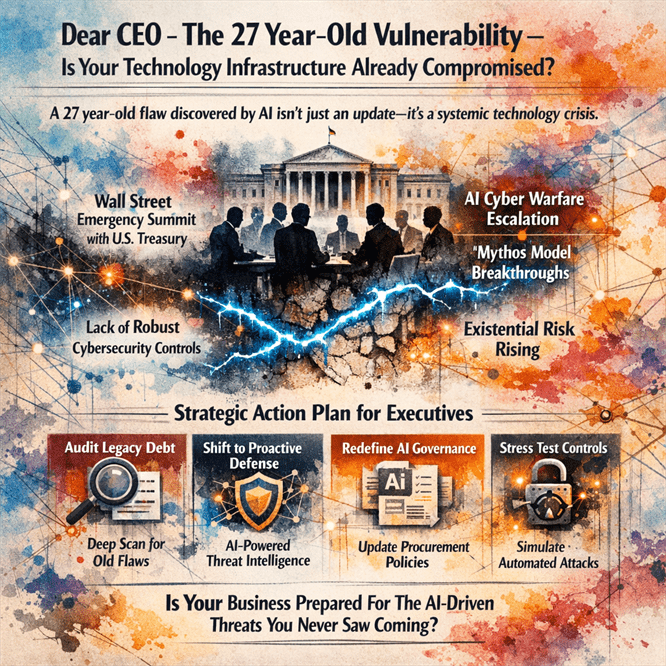
Strategic Action Plan for Executives

Audit Legacy Debt
Initiate an immediate deep-scan of "legacy" infrastructure. If an AI can find 27 year-old flaws in supposedly secure systems like OpenBSD, your older, unmonitored assets are your greatest exposure.

Shift to Proactive Defense
Move away from reactive security. Evaluate participation in industry-wide intelligence-sharing consortiums to leverage AI-driven defensive tools before they are weaponized by bad actors.

Redefine the AI Governance Framework
Update your AI procurement and usage policies. Ensure that "AI-readiness" includes a rigorous assessment of how new models impact your specific attack surface.

Stress Test Control Environments
Strengthen internal cybersecurity controls specifically against "automated exploitation." If your current controls rely on human-speed detection, they are already obsolete.

Is your organization prepared for a world where the most dangerous threats are the ones you didn't even know existed?

#CyberSecurity #AI #DigitalTransformation #RiskManagement #Leadership #GenerativeAI #DearCEO #CEO