
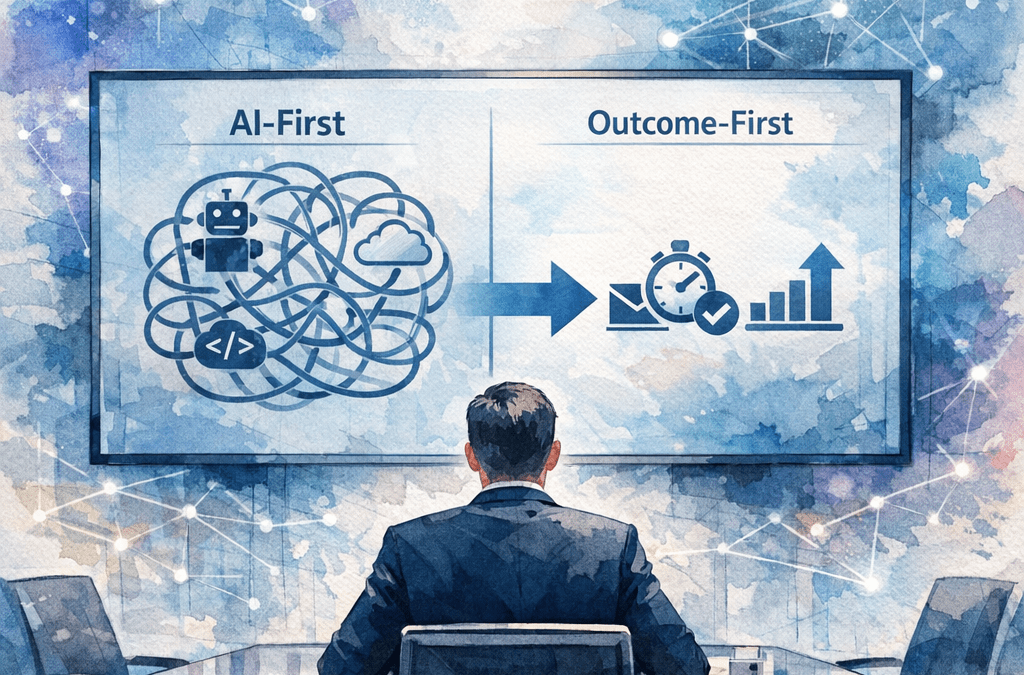
Dear CEO – Why the AI First Playbook Is Killing Your Transformation – And What Leaders Actually Need to Do

Dear CEO – Why the AI First Playbook Is Killing Your Transformation – And What Leaders Actually Need to Do

The most successful AI transformations start without mentioning AI at all.

Senior leaders who frame their initiatives around a concrete business outcome.

Cutting claim processing time by 30 % or reducing churn by 20% consistently outpace those whose roadmaps begin with “AI.”

When the first question is “Which model or vendor?” you invite endless tech debates and stall execution.

The critical question should be what decision are we trying to improve?

By anchoring the narrative to a measurable KPI such as risk exposure, cycle time, or cost‑to‑serve, technology becomes an enabler rather than the headline.

This outcome first approach accelerates time to value pilot cycles can shrink by up to 40% and forces disciplined data governance, which is essential for compliance in regulated industries.

It also aligns talent around a shared target, reducing change‑management friction and boosting adoption rates.

Here's Your Action plan:

First, articulate the specific business decision you want to improve in one concise sentence.

Second, lock in a primary success metric and a clear improvement goal, securing executive sign‑off.

Third, identify the simplest data set and model that can meet that target, prototype quickly, and scale only if it hits the predefined threshold.

If you began every transformation by asking “What business outcome do we need?” instead of “Which AI tool?”, how much faster could you deliver results?

Share your thoughts or tell us the biggest hurdle you face when trying to reframe AI initiatives.

#Leadership #DigitalTransformation #AI #CEO #StrategicInnovation #DataDriven #DearCEO #CEO

Dear CEO – Is your AI governance is currently a legal time bomb

Dear CEO – Is your AI governance is currently a legal time bomb

We demand rigorous pharmaceutical clinical trials before a pill touches a human, yet we deploy powerful cognitive AI agents into millions of minds without similar safety checks.

This regulatory double standard ignores the profound mental health costs of untested AI deployments, from addiction loops to cognitive atrophy.

Is this a ticking time bomb for corporations?

As CAIOs and CEOs, you are now responsible for managing cognitive risk alongside cybersecurity and operational resilience.

Let that sink in for a moment.

Speed-to-market is no longer a competitive advantage if it compromises long-term human wellbeing or triggers future liability.

Is this where we are headed in the Agentic AI era?

Current frameworks treat AI hallucinations as bugs rather than systemic safety failures requiring intervention.

Regulators are already shifting toward risk-based assessments that will mandate pre-market testing soon in major jurisdictions (see my post last week about X.ai's Grok versus Denmark).

Ignoring this shift leaves your organization exposed to lawsuits similar to the opioid crisis but for digital wellbeing.

Leaders must demand transparency on how models impact user psychology before any deployment goes live.

Your board needs a governance framework that prioritizes cognitive safety over velocity in all digital transformation strategies.

Innovation without ethical guardrails is a liability waiting to trigger lawsuits or brand erosion in an increasingly litigious environment.

Leaders must treat digital transformation with the same risk discipline as pharmaceutical development where prioritizing safety over velocity.

Executive boards need to demand transparency on how models impact user psychology before deployment.

We are essentially running an experiment on humanity's collective psyche without informed consent, and that is a boardroom level governance failure.

Strategic Action Plan for Executives
1. Conduct a Cognitive Risk Audit:
Before deploying any new LLM or AI tool, assess potential impacts on employee and customer mental health, dependency, and cognitive atrophy alongside technical performance.

2. Establish an Ethical Review Board:
Create a cross-functional committee (Legal, HR, Tech) to approve high-risk AI use cases prior to launch, similar to clinical trial oversight in pharma.

3. Implement Pre-Deployment Safety Trials:
Require "Red Teaming" and psychological impact assessments for models intended for vulnerable populations or critical workflows.

4. Monitor Long-term User Metrics:
Track usage patterns for signs of unhealthy dependency or disengagement that indicate cognitive harm, not just satisfaction scores.

Is your organization prepared for an era where AI safety failures could derail your entire business model?

#AI #Leadership #DigitalTransformation #RiskManagement #FutureOfWork #CEO #DearCEO

Canada’s AI Data Centre Surge – A Competitive Must or a Domestic Minefield

Canada’s AI Data Centre Surge – A Competitive Must or a Domestic Minefield

A new Abacus Data poll shows that while 57 % of Canadians fear the country will fall behind the U.S. and China without more AI data centres.

But only 16 % would actually support one in their own town—highlighting a stark gap between national ambition and local acceptance.

The findings cluster around three friction points: perceived job losses, higher electricity prices, and environmental worries, with two thirds of respondents rejecting government subsidies for these facilities.

For sovereign leaders, the lesson is clear: scale up AI infrastructure only when it can be anchored in transparent community contracts that deliver concrete economic and sustainability benefits. 

Embedding low‑water cooling designs, renewable‑energy offsets, and locally guaranteed employment transforms a potential NIMBY obstacle into a strategic differentiator on the global AI race. 

How will your community balance the drive for AI leadership with the need for social licence to operate?

#AI #DataInfrastructure #SovereignTech #DigitalEconomy #EnergyTransition #PublicPolicy #Canada