Dear CEO – Chatbots lie. Agents act. One is a nuisance; the other is a liability.

Dear CEO – Chatbots lie. Agents act. One is a nuisance; the other is a liability.

We are moving from asking AI what it thinks to letting AI do what it does.

Microsoft is consolidating Copilot into a single platform.

Satya Nadella says trust is the primary hurdle as AI moves from answering prompts to performing autonomous tasks.

This shifts enterprise risk.

A chatbot's mistake is a wrong answer.

An agent's mistake is a sequence of unauthorized actions that propagate through your systems before anyone notices.

The risk has shifted from text to logic.

Guardrails catch toxic language.

They won't catch a logic error in step four of a five step process that triggers an unauthorized data transfer.

1. Map every agentic workflow to a mandatory human intervention node.

2. Shift audit focus from text verification to logic path traceability.

3. Define liability boundaries for non human identities before they gain system access.

If an agent fails in the middle of a multi step sequence, will you have the logs to find the point of failure, or just the wreckage?

#AIGovernance #AgenticAI #EnterpriseAI #DataGovernance

Big Tech’s Warped Perception

Big Tech’s Warped Perception

Big Tech leaders at the Global Risk Institute event in Toronto this week focused on frontier AI model costs being their cheapest ever while also dismissing the cost competitiveness of building internal enterprise Gen AI capabilities using open weight models.

They missed the threat to your intellectual property.

If your core operations rely on third party models, your trade secrets risk becoming training data for your competitors.

For an executive, losing your competitive advantage is a survival issue that outweighs the monthly subscription.

I have found success in licensing technology for commoditize enterprise capabilities while maintaining sovereignty over core business services.

This is key.

As you automate, how much of your proprietary logic are you willing to risk for the sake of convenience?


Dear CEO – Your Most Critical Data is Rotting

Dear CEO – Your Most Critical Data is Rotting

Your real competitive advantage is hidden in the messy friction of how work happens.

You believe you are ready for AI because your CRM and ERP systems are clean.

You have spent years perfecting your master data.

But 80 to 90 percent of enterprise data is unstructured.

This dormant data lives in documents (network shares, SharePoint, etc.), meeting transcripts, chat logs, and email threads.

It is the unrecorded truth of how your company operates.

I recently worked with a regulated client where our agents scanned these archives to uncover this hidden corporate intelligence.

We uncovered a mountain of unfulfilled regulatory obligations, hidden in documents that no one had the time to read.

These were not just errors, they were risks that had been operating in the dark for years with financial consequences.

If you only train your AI on the polished data within your CRM or ERP, you are building a faster way to automate your company's official delusions.

You are optimizing the part of the business that people have already sanitized.

Truth is messy.

Risk lives in the gap.

Do not wait.

This process is about building an audit trail of truth.

It is about seeing the difference between what was promised and what was delivered.

Deploy agents to find the messy truth.

Use the findings to bridge the gap between reporting and reality.

Build a system that turns unrecorded history into a defensible asset.

Start with one small loop.

#AI #DataGovernance #RiskManagement

Dear CEO – The end of the AI rental economy

Dear CEO – The end of the AI rental economy

Dear CEO: The end of the AI rental economy

If you rely on third party models, you are leaving your most valuable IP in a black box.

Renting intelligence is a race to the bottom for your margins and your data.

Microsoft and Meta are already seeing the limits of the subscription model.

Meta saw their Claude Code user count drop from 60,000 to 30,000 as they prioritized their own internal tools.

Meanwhile, MetaCode has surpassed 30,000 users by using models the company actually owns.

An enterprise needs a model that learns from proprietary workflows rather than one that merely boasts a high benchmark score.

It must protect your secrets from third party vendors.

The intelligence is yours.

At Alidade, we have spent the last two and a half years running open weights models specifically to automate our own work, protect client IP, and ensure we understand every nuance of this technology.

Your may worry that your own stack requires too much specialized talent.

This is true for a pilot, but it is a mistake for a core capability.

When you expand, the cost of licensing an external model will dwarf the cost of managing your own infrastructure.

The cost is high.

It is inevitable.

#AIStrategy #SovereignAI #DataGovernance

Dear CEO – Take Note of the Intelligence Exit Trap

Dear CEO – Take Note of the Intelligence Exit Trap

You think you are building an enterprise asset.

You might be building a high performance rental.

The gap between data ownership and intelligence ownership is where most AI strategies fail.

A recent report in Inc. highlighted how companies are inadvertently leaking their competitive advantage through thousands of small, unmonitored prompts sent to frontier AI models.

In my consulting engagements, clients are consistently surprised by the data management practices of these vendors and how they do not actually own the new assets they have built.

When your proprietary decision making logic is inextricably tied to a specific vendor's inference architecture, you have not built a company asset. You have built a recurring operational expense.

Some argue that deep integration with a single provider is necessary to achieve the performance required for enterprise utility.

Speed and performance are important but performance without sovereignty is a trap that makes you a hostage to a vendor's pricing and roadmap.

1. Audit the intelligence exit risk in every pilot.

2. Prioritize architectures that allow you to move your logic between models without losing the underlying capability.

3. Build sovereignty into the infrastructure.

Dear CEO – Your Employee’s AI agents are building unauthorized dossiers on your clients

Dear CEO – Your Employee’s AI agents are building unauthorized dossiers on your clients

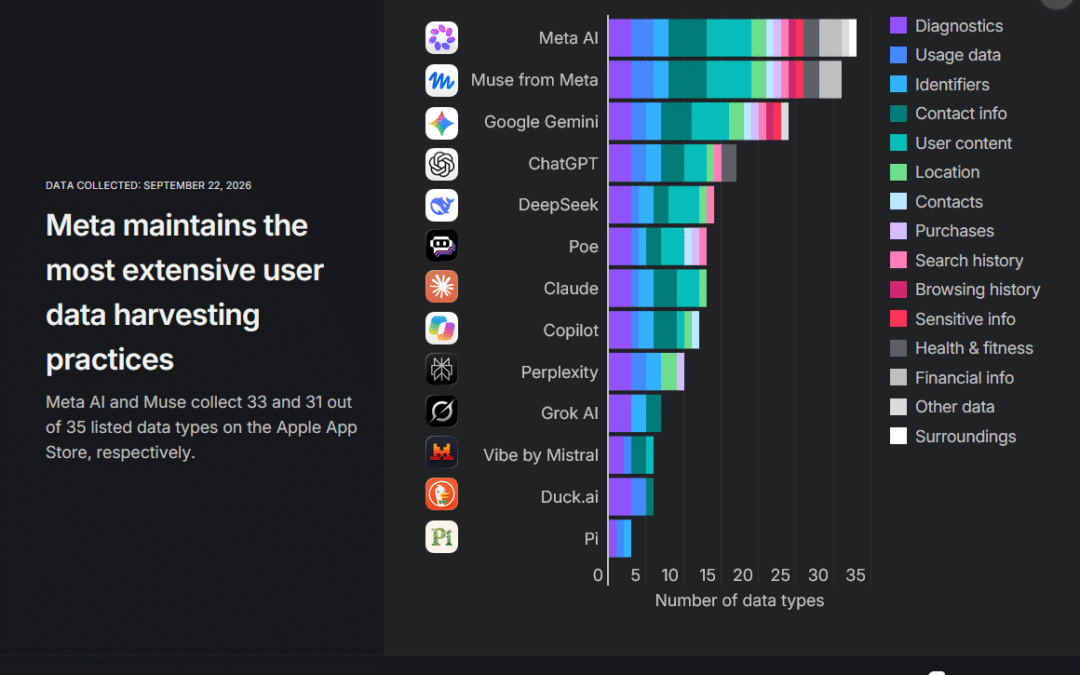
Your employees' AI agents (Meta Muse) are building unauthorized dossiers on your most important clients.

The transition from chatbots to agents is quietly breaking the concept of individual consent.

Reports from WIRED regarding Meta’s Muse agent show that these tools move beyond simple chat to build relational models.

The agent compiles one page profiles on a user's contacts, including family, colleagues, and collaborators.

This is a privacy concern for consumers, but for the enterprise, it is a massive, unquantified legal risk.

When an agent extracts inferred details about a third party, such as their personal habits or relationship history, to provide context to a user, it is generating data on someone who never signed your terms of service.

The risk is real.

One may argue that agents need this context to be useful and that users can simply opt out of sharing.

Opting out of a single app does nothing to address the unauthorized creation of a profile on a person who has no relationship with the app.

You cannot opt out of a dossier that was built using someone else's data.

1. Audit your AI usage to see if employees are feeding client data into agents that create persistent memories.

2. Update your third party risk assessments to account for inferred relational data.

3. Define where permission ends.

Does your current AI governance framework distinguish between a user's own data and the inferred data an agent gathers about their professional network?

Image credit: SurfShark

#AIGovernance #DataPrivacy #AgenticAI #EnterpriseRisk #AICompliance