Dear CEO – Is Your Firm Training Its Replacement – The AI Threat to Knowledge-Based Businesses

Dear CEO – Is Your Firm Training Its Replacement – The AI Threat to Knowledge-Based Businesses

If your business is knowledge, you have a problem.

A big one.

And you might be inadvertently fueling it.

Think about it: for decades, your expertise – your deep understanding of finance, medicine, law, engineering – was your moat.

It was what set you apart.

But now, that same knowledge is being vacuumed up by Big Tech, who are using it to build generative AI that could render your services obsolete.

OpenAI isn't just hiring engineers anymore.

They're raiding Wall Street and poaching medical experts to build specialized AI that replicates and potentially surpasses human capabilities.

It's an ironic twist: we’re helping them train our own obsolescence and they make the future revenue.

Here’s what executives need to be doing, and why:

Action 1: Radical Self-Assessment.
Honestly evaluate how AI can disrupt your core business model. Don't sugar coat it.

Action 2: Forge Strategic Partnerships (Carefully).
Explore collaborations with AI developers, but with eyes wide open. Understand who owns the data and the resulting IP.

Action 3: Focus on Uniquely Human Skills.
Double down on creativity, critical thinking, complex problem-solving, and emotional intelligence – the things AI can’t easily replicate.

Action 4: Become AI-Native.
Don't fight the tide. Embrace AI as a tool to augment your workforce and enhance your services.

Reflective Questions for Executives:

- Are you truly understanding the existential threat AI poses to our business model?
- Are you actively monitoring Big Tech’s AI initiatives and anticipating their impact on our industry?
- Are you fostering a culture of innovation and experimentation, or are we clinging to outdated practices?
- Are you willing to cannibalize our existing business to create new opportunities in the age of AI?
- What’s your plan for retaining and reskilling our workforce to thrive in an AI-driven future?

Are you facing the music and preparing for the AI revolution, or are you waiting for the inevitable disruption to arrive?

#AI #Disruption #Innovation #BigTech #ExistentialThreat #Leadership #DearCEO #CEO

Dear CEO – Canada’s Hidden Tech Dependency

Dear CEO – Canada’s Hidden Tech Dependency

63% of Your Business Apps Are American‑Owned – What That Means for Sovereignty and Profit

A new analysis shows that nearly two‑thirds of the 700+ software tools powering Canadian enterprises are owned by U.S. firms.

Yet only 17 % come from truly Canadian‑headquartered companies.

Because most “Canadian‑data‑residency” apps fall under the U.S. CLOUD Act, American authorities can compel data disclosure even when servers sit in Canada, creating privacy and compliance risks for CEOs and CDOs.

U.S. vendors capture the bulk of IP ownership and subscription revenue, leaving Canadian innovators under‑funded and limiting strategic control over critical codebases.

Understanding this supply‑chain opacity lets CIOs/CAIOs redesign procurement gates, demand transparent parent‑company disclosures, and prioritize solutions that can be run on domestic infrastructure—turning a sovereignty risk into a competitive advantage.

Action Plan for Executives
1. Audit & Map
Within 30 days, launch a cross‑functional audit of all SaaS contracts to map each tool to its ultimate parent company and jurisdiction. Use a simple spreadsheet or procurement‑tool integration to flag any U.S.–controlled services.

2. Policy Upgrade
Revise internal procurement guidelines to require “parent‑company disclosure” clauses and give scoring weight to domestic governance (e.g., +5 pts for Canadian‑controlled IP). Align this with the upcoming Buy‑Canadian Procurement Framework.

3. Strategic Substitution
Identify the nine software categories lacking any Canadian provider (as highlighted in the study) and prioritize investment or partnership opportunities that either: a) bring open‑source alternatives under internal control, or b) co‑develop with emerging Canadian vendors to build a homegrown portfolio within 12–18 months.

Are you willing to let foreign tech firms dictate the fate of your data and profits, or will you reshape your tech stack before the next policy shift forces your hand?

#DigitalSovereignty #TechStrategy #DataPrivacy #ProcurementInnovation #AILeadership #FutureOfWork #CEO #DearCEO

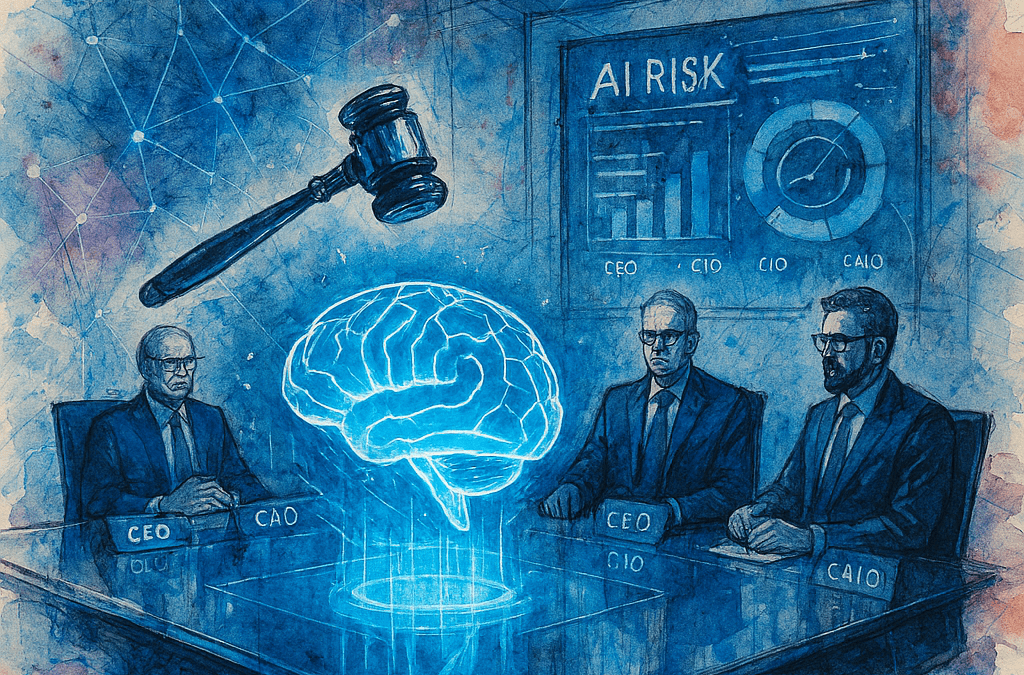
Dear CEO – Stop Asking If AI Is Safe — Start Demanding Accountability

Dear CEO – Stop Asking If AI Is Safe — Start Demanding Accountability

“Is AI safe?” is a question that stalls leadership.

The real test is who’s accountable when it isn’t?

Safety, as most executives treat it, is an abstract promise and accountability is an operational contract.

When deployment decision rights and veto authority aren’t defined, incidents become a game of blame diffusion rather than risk mitigation.

For CEOs, CIOs, CDOs, and CAIOs, explicit ownership translates into faster, trustworthy roll‑outs, protected brand reputation, and clearer regulatory compliance pathways.

Start by mapping every AI decision point to a named steward with veto power and an audit trail that surfaces the moment something deviates from policy.

Action Plan for Executives

1. Map Decision Rights
Create a living diagram that links every AI model, data pipeline, and deployment stage to a specific executive owner (e.g., CIO for infrastructure, CDO for data quality, CAIO for ethical use).

2. Establish an AI Accountability Board
Convene cross‑functional leaders with veto authority who review high‑impact AI releases before go‑live and conduct post‑incident reviews.

3. Embed Auditable Controls
Deploy automated logging of model inputs/outputs, decision overrides, and compliance checks; integrate these logs into your existing GRC platform for real‑time visibility.

4. Run Table Top Simulations
Conduct quarterly tabletop exercises that simulate AI failures or ethical breaches, testing the effectiveness of decision‑rights, veto protocols, and incident‑response playbooks—then refine governance based on the findings.

What concrete mechanisms have you instituted today to hold your organization answerable for AI outcomes?

#Leadership #AI #Accountability #DigitalTransformation #RiskManagement #CIO #DearCEO #CEO

Dear CEO – The AI Revolution- Are We Building the Grid, or Just Plugging In

Dear CEO – The AI Revolution- Are We Building the Grid, or Just Plugging In

A New Era of Strategic Infrastructure

We’re hearing a lot about AI, but are we truly grasping the magnitude of its potential?

Reflecting on the current landscape, it’s striking how closely the AI revolution mirrors the early days of electricity.

Think back: electricity wasn't just about light bulbs; it sparked entirely new industries—washing machines, refrigerators, manufacturing processes—built around a foundational infrastructure.

Today, we’re largely in that same "infrastructure build-out" phase for AI.

We're focused on the underlying models, the data pipelines, the compute power – the very foundation upon which future AI-powered solutions will be built.

This means the next wave of competitive advantage won't just be about experimenting with AI tools; it will be about strategically architecting entire systems and business models that leverage this emerging AI platform.

For executives, this demands a fundamental shift in perspective: move beyond viewing AI as a series of projects and start envisioning it as the very bedrock of future operations, innovation, and even entirely new revenue streams.

Are you building the future organization, or simply waiting for someone else to power it?

Let’s discuss how your organization is positioning itself to become an architect of the AI-driven economy, not just a consumer.

#AIStrategy #DigitalTransformation #ExecutiveLeadership #Innovation #FutureofWork #AIInfrastructure #DearCEO #CEO

Dear CEO – Why the Next Employee Perk Will Be an AI Token Bank — Not a Stock Option

Dear CEO – Why the Next Employee Perk Will Be an AI Token Bank — Not a Stock Option

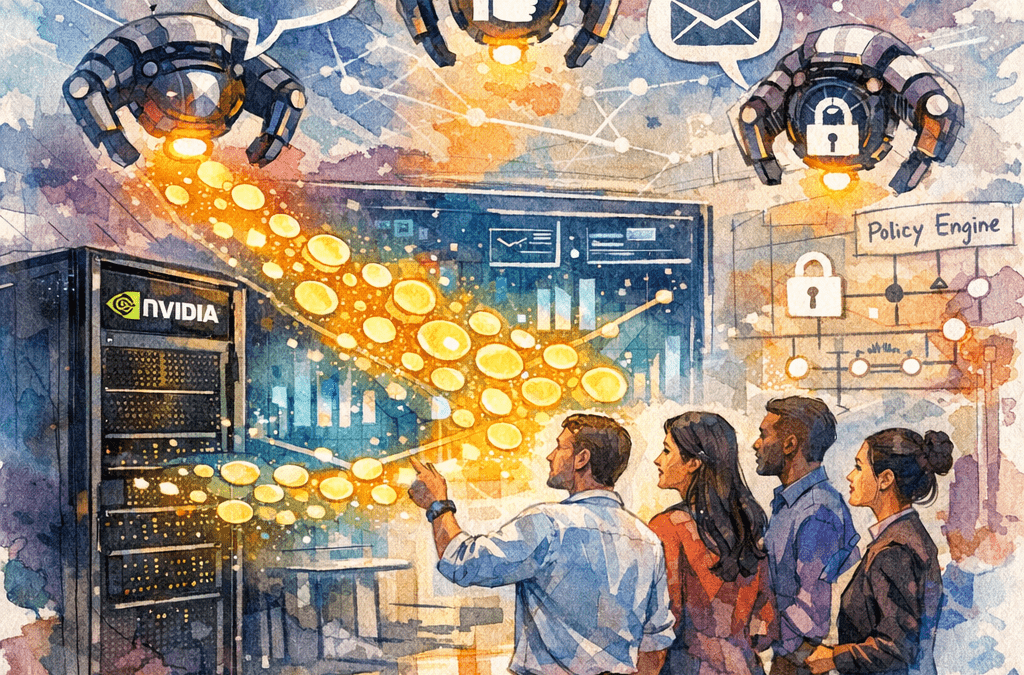
Earlier this week Jenson Hwang (NVIDIA's CEO) keynote announced that “every engineer will need an annual token budget to be roughly half of their base salary paid as AI‑tokens to amplify productivity 10×.”

This creates a new hiring perk that can attract top talent while giving employees a measurable “AI spend” they can use to call on autonomous agents, schedule cron jobs or retrieve data in any modality.

At the same time, the Big Tech industry is signalling moving from flat‑rate SaaS licences to a utility‑pricing model for agentic AI.

You pay per token consumed rather than a static subscription.

Get Ready!

To succeed, every enterprise must adopt an agentic‑AI strategy with built‑in policy engines and privacy guardrails that keep token‑driven agents from leaking sensitive data.

For CEOs, CHROs and CAIOs this means a new line‑item on the P&L, fresh talent‑acquisition levers, and an urgent need to embed token accounting into HR, finance and security workflows.

Are you ready to redesign compensation and governance around AI tokens, or will your organization be left behind in the agentic era?

#AILeadership #AgenticAI #DigitalTransformation #FutureOfWork #TokenEconomics #EnterpriseSecurity #CEO #DearCEO

Dear CEO – Your AI Playbook Expires in 18 Months – Why a Five‑Year Plan Is Now a Liability

Dear CEO – Your AI Playbook Expires in 18 Months – Why a Five‑Year Plan Is Now a Liability

You spent six months building an AI strategy.

It was obsolete before the ink dried.

That is not a failure.

It is the physics of this moment in technology history.

In most domains, a multi-year strategy is a reasonable management instrument.

With AI, it is a liability.

The capability landscape such as the Gen AI models, infrastructure, cost curves, regulatory posture, use cases are shifting so rapidly that any strategy with a three to five-year horizon is making foundational bets on a world that will not exist.

Smart organizations are replacing static AI strategies with rolling capability reviews, 90-day execution sprints, and scenario based planning that treats uncertainty as an input rather than an obstacle.

The question is not what is your AI strategy for 2028.

It is how do we make better AI decisions every quarter.

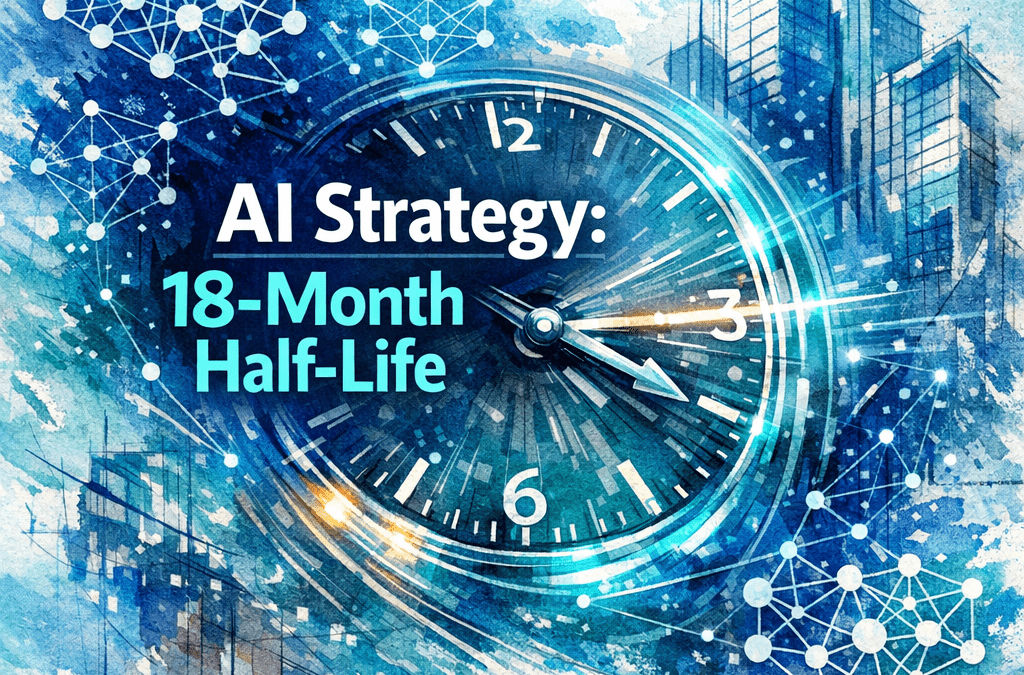
The reality of AI today is a half‑life of 18 months.

Models, infrastructure costs, vendor capabilities and regulations evolve so fast that any multi‑year roadmap is a gamble on a future that won’t exist.

Why it matters:
Executives who shift from “AI 2028” to “AI every quarter” unlock faster time‑to‑value, reduce sunk cost risk, and keep their organizations ahead of regulatory and cost curves.

Your competitive edge depends on how quickly you can decide not on how long your plan lasts.

Start by mapping the AI landscape on a quarterly basis this becomes your “living strategy”.

Then run focused 90‑day sprints that deliver tangible outcomes, feeding results back into the next radar.

Finally, embed scenario planning into every sprint review so uncertainty drives action rather than paralysis.

Executing this loop turns rapid change from a threat into a competitive advantage.

Your 3‑step Checklist Action Plan

1. Quarterly Capability Radar
Convene a cross‑functional AI council every 90 days to map new model releases, cost trends, and regulatory updates. Document gaps vs. current stack.

2. Sprint‑Based Execution
Translate radar insights into 30‑day sprints with clear KPIs (e.g., prototype a new LLM, pilot a cost‑optimization tool). Review outcomes before the next sprint.

3. Scenario Playbooks
Develop three concise playbooks (optimistic, realistic, pessimistic) outlining resource allocation and risk mitigation for each AI trajectory. Update them after every radar session.

#AILeadership #DigitalTransformation #StrategicPlanning #CEO #CAIO #Innovation #DearCEO